
Strategies for Injury Prevention and Legal Protection
 Article
 by UK Coaching
As a coach, your ultimate aim is to support your participants to reach their full potential. But here is the thing, you can’t maximise development opportunities if your participants are sidelined by injuries.
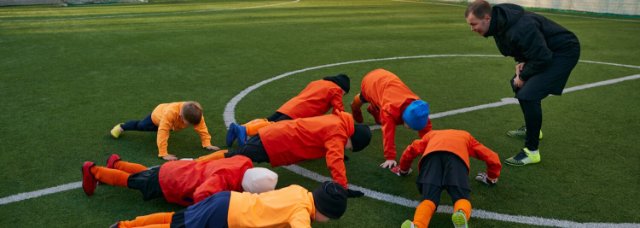
By following a few key principles, you can prevent injuries, protect yourself from liability, and create a thriving environment for your participants.

Follow Approved Coaching Practices
Coaching is not just about intuition or tradition; it’s about judgements and making decisions that are reasonable and grounded in accepted standards. This means coaching within the boundaries of what’s considered safe and effective for your participants’ age, experience, skill level, and sport or physical activity.
Following approved practices is not just about avoiding lawsuits, it's about creating a culture of learning, safety and trust. When participants know you are making decisions with their best interests in mind, they’re more likely to perform at their best.
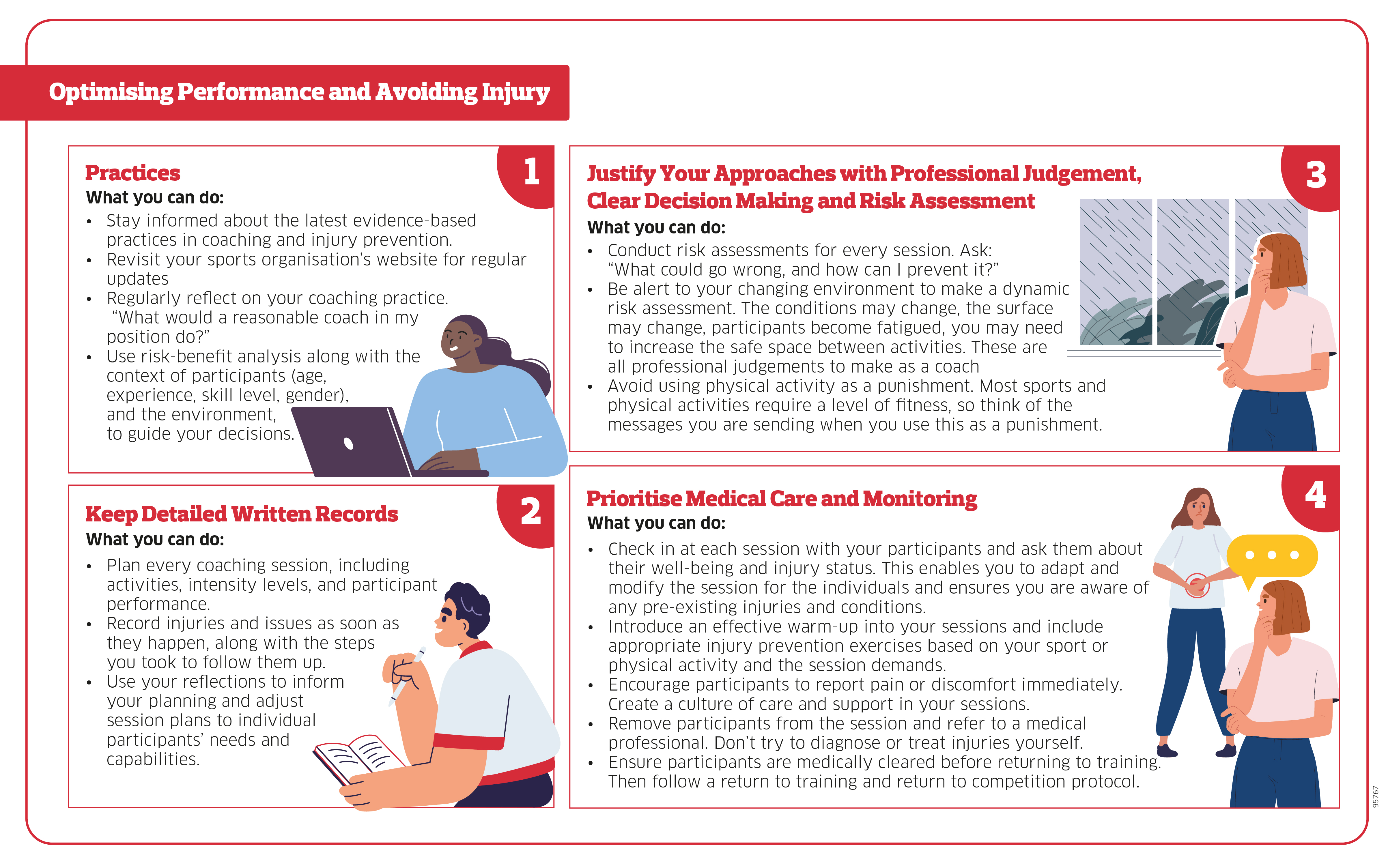
What you can do:
- Stay informed about the latest evidence-based practices in coaching and injury prevention.
- Revisit your sports organisation’s website for regular updates
- Regularly reflect on your coaching practice. “What would a reasonable coach in my position do?”
- Use risk-benefit analysis along with the context of participants (age, experience, skill level, gender) and environment to guide your decisions.

Keep Detailed Written Records
Documentation might not sound exciting, but it’s one of the most powerful tools you have as a coach. Detailed records of training sessions, injuries, and participant progress can help you monitor training loads, identify potential risks, and prove, should you need it, a clear record of how you responded, monitored and acted in a situation, should any challenges arise.
What You Can Do:
- Plan every coaching session, including activities, intensity levels, and participant performance.
- Record injuries and issues as soon as they happen, along with the steps you took to follow them up.
- Use your reflections to inform your planning and adjust session plans to individual participants’ needs and capabilities.

Justify Your Approaches with Professional Judgement, Clear Decision Making and Risk Assessment
Even if a practice or approach is widely accepted within your sport or physical activity, it’s your role to ensure that you logically explain the reason and rationale to your participants and coaching team. This includes evaluating potential risks, considering the age and skill level of your participants, and avoiding or adjusting practices that could cause harm (to an individual or the whole group).
When you can justify your methods, you are not just preventing injuries, you are building confidence in you as a coach and your approach to coaching. Your participants will increase their trust in you, that you are coaching with them as a person first and always.
What you can do:
- Conduct risk assessments for every session. Ask: “What could go wrong, and how can I prevent it?”
- Be alert to your changing environment to make a dynamic risk assessment. The conditions may change, the surface may change, participants may become fatigued, you may need to increase the safe space between activities. These are all professional judgements to make as a coach
- Avoid using physical activity as a punishment. Most sports and physical activities require a level of fitness. Think of the messages you are sending when you use this as a punishment.
When delivering conditioning activities and sessions with high load, intensity or increased risk be cautious and monitor for any signs of fatigue or danger that increases the risk. Reducing the session by time, reducing the intensity, adjusting the level of physicality or modifying the activity by reducing the distance covered allows you to manipulate and meet the needs of the participants in your session.

Prioritise Medical Care and Monitoring
Injuries are unfortunately a part of sport and physical activity, but how you manage them in your environment can make all the difference when it comes to avoiding negligence claims and allegations. Taking precautions with medical provision and monitoring ensures your participants stay healthy and reduces the risk of long-term damage to the health of the participants (and also your coaching career!).
What you can do:
- Check in at each session with your participants and ask them about their well-being and injury status. This enables you to adapt and modify the session for the individuals and ensures you are aware of any pre-existing injuries and conditions.
- Introduce an effective warm-up into your sessions and include appropriate injury prevention exercises based on your sport or physical activity and the session demands.
- Encourage participants to report pain or discomfort immediately. Create a culture of care and support in your sessions.
- Remove participants from the session and refer to a medical professional. Don’t try to diagnose or treat injuries yourself.
- Ensure participants are medically cleared before returning to training. Then follow a return to training and return to competition protocol.
Finding the Sweet Spot: Balance Key to Effective Coaching Behaviours
Coaching practices can be thought of as a continuum. On one side, there is an authoritative approach, pushing participants hard, and focusing on the activity rather than the person. On the other hand, a Laissez faire approach has the potential of being too relaxed, not challenging participants, and stifling their development.
Previous experiences may impact on how you support and challenge your participants. Having a close call previously with an injury you feel you could have prevented or having been challenged for your coaching style in the past, may influence the level of challenge you feel you are able to provide your participants.
In response, you might dial back the intensity, avoid challenging your participants, or shy away from holding them accountable. While this approach might feel safer, it can be just as harmful for their development. Both extremes of the continuum lead to ineffective coaching and, yes, injuries.
As an example, a basketball coach allows players to choose their own training intensity and practices, aiming to create a ‘player-led’ environment, because the previous year’s feedback said his coaching style and behaviours were too controlling. This led to inconsistent training loads, with some players overtraining and others undertraining. This resulted in several players developing overuse injuries due to the lack of a planned and structured programme. The coach’s reluctance to provide a structured, considered and balanced training programme increased the risk of injury.
A high school strength and conditioning coach observed and allowed participants to use improper lifting techniques during weight training sessions, fearing that correcting them would discourage participation. One participant suffered a herniated disc due to poor form during a deadlift. The coach failed to provide an appropriate level of instruction and supervision because he was too concerned about his participants enjoying his training sessions.
Without structure, accountability, and clear expectations there is no challenge and development declines, and people’s potential is missed. Worse, participants may even become complacent or disengaged, leading to a lack of focus and attention that can increase the risk of injury. Challenge and support are important tools in the coach’s kitbag and need to be used to achieve the right balance.
The Coaching Continuum: Where do you stand?
Read through each of the coaching scenarios and consider where you would be on the continuum. Be honest with your initial assessment before reflecting on what you would do differently now.

Coaching Story: Over-Reliance on Direct Instruction
A basketball coach micromanaged a player’s every move, threatening to bench them if they did not follow strict instructions. The player, afraid of losing their spot, pushed through fatigue and pain, eventually suffering a stress fracture.
Over-controlling participants limits their ability to listen to their bodies. When they’re forced to follow rigid instructions without room for self-regulation, they’re more likely to ignore pain signals and overexert themselves for fear of being dropped and falling out of favour with the coach.
Encourage participants to be independent and make decisions for themselves and create a culture of open communication and psychological safety. Participants need to understand their bodies and recognise their limits. Prioritise well-being, recovery and safety over compliance.
Coaching Story: Lack of Feedback
A coach rarely gave a gymnast constructive feedback on important aspects of the apparatus, such as proper technique and training intensities. Even though the gymnast was not performing the exercises routine correctly, the coach thought he would figure it out. The gymnast continued to train very hard, however he was not performing a safe landing technique and subsequently sustained a serious knee injury.
When there is a lack of constructive feedback, participants can be unaware of the risk and dangers they may be subjecting themselves to. Provide effective feedback on proper technique and be vigilant to safety measures through appropriate supervision and support at all times. Do not assume participants will adapt and learn without support, assistance and encouragement through progressive development.
Coaching Story: Controlling Behaviours
A coach dictated what participants could eat, insisting they weigh their food and even suggesting they go to bed hungry to “burn more fat.” One participant developed an eating disorder and suffered RED-S (Relative Energy Deficiency in Sport) from overtraining.
Excessive control and exertion of power over participants can harm their physical and mental health, leading to disordered eating, bone health, burnout and injuries. Take a holistic approach to your coaching programme and develop, through deliberate and informal approaches, your participants’ approach to their development. Consider rest, recovery, hydration, nutrition, sleep as well as physical and mental well-being. Encourage individuals to make informed choices and decisions and take responsibility for their development.
Coaching Story: Lack of Warm-Up
A coach missed the use of warm-ups to save time during their sessions and assumed the participants would organise their own cool-downs at the end of sessions and competitions, leading to an increase in muscle strains and injuries.
A lack of warm-up increases the risk of injury as the individuals are not physically and mentally prepared for the activity and session ahead. The use of a gradual and progressive RAMP warm-up ensures that the intensity of the session gradually increases, the heart rate is increased, movement patterns and mobility is explored and the participants are primed psychologically and physically for the session.
Coaching Story: Ignoring Environmental Conditions
A coach holds practice in hot weather without providing adequate water breaks, without ensuring the individuals have sun protection and without taking rest windows in the shade. Over the course of the 90-minute coaching session several participants report feeling unwell and are later found to be suffering from heat exhaustion.
Failing to consider the environmental conditions like heat, cold, or poor air quality can lead to many issues for participants.
In this instance, the coach should have monitored the weather, potentially used a group communication to remind them to wear sun cream, cover up and bring a hat. On arrival the coach should have checked that everyone had applied sun cream, ideally brought spare to pass to those who had forgotten, and role modelled good practice by applying in front of the participants. During the session the coach should have found a shaded area to leave items and adjust the activities and intensity accordingly whilst providing plenty of water and breaks in the shade.
Conclusion
The relationship between sports coaching and negligence law has transformed modern coaching practices. Coaches must balance their duty of care with effective training methods, maintaining their knowledge and personal development to keep their practices relevant, evidence-informed and current. The legal framework requires all coaches, whether volunteer or paid, to demonstrate appropriate skill and care in their roles.
Coaches must navigate the delicate balance between participant development, improved performance and appropriate practice and safety.
The law recognises that coaching decisions exist within a reasonable range of options, allowing for creativity and flexibility in coaching approaches. The key is understanding these boundaries and applying appropriate coaching knowledge and decisions based on context and participant experience.
Remaining aware of your responsibilities as a coach and understanding your legal obligations is an important part of the role of the coach to ensure you maintain your duty of care to your participants.
Cases:
Bolam v Friern Hospital Management Committee [1957] 2 All ER 118
Brady v Sunderland AFC [1998] EWCA Civ 1780
Davenport v Farrow [2010] EWHC 550
Articles:
Cushion, C., & Jones, R. L. (2006). Power, Discourse, and Symbolic Violence in Professional Youth Soccer: The Case of Albion Football Club. Sociology of Sport Journal, 23(2), 142–161.
Ekstrand J., Lundqvist D., Lagerbäck L., Vouillamoz M., Papadimitiou N., & Karlsson J. (2018). Is there a correlation between coaches' leadership styles and injuries in elite football teams? A study of 36 elite teams in 17 countries. British Journal of Sports Medicine, 52(8), 527-531.
Partington, N. (2016). Sports coaching and the law of negligence: Implications for coaching practice. Sports Coaching Review, 6(1), 36–56. https://doi.org/10.1080/21640629.2016.1180860
Reports & Guidelines:
Alexander, K., Stafford, A., & Lewis, R. (2011). The Experiences of Children Participating in Organised Sport in the UK. NSPCC, London. Retrieved from http://www.nspcc.org.uk/Inform/research/findings/experiences_children_sport_wda85008.html
International Olympic Committee (IOC). (2016). Consensus Statement on Training Load in Sport.
National Strength and Conditioning Association (NSCA). (2019). Coaching Guidelines for Safe and Effective Training.
UK Coaching. (2021). Duty of Care in Sport.
UK Health and Safety Executive (HSE). (2020). Risk Assessment in Sport.
UK Sport. (2022). Good Governance in Coaching.