
Athletic Development and Physical Preparation Guide
 Article
 by UK Coaching
With this comprehensive guide, you'll develop the essential foundations that will enable your participants to engage in lifelong physical activity

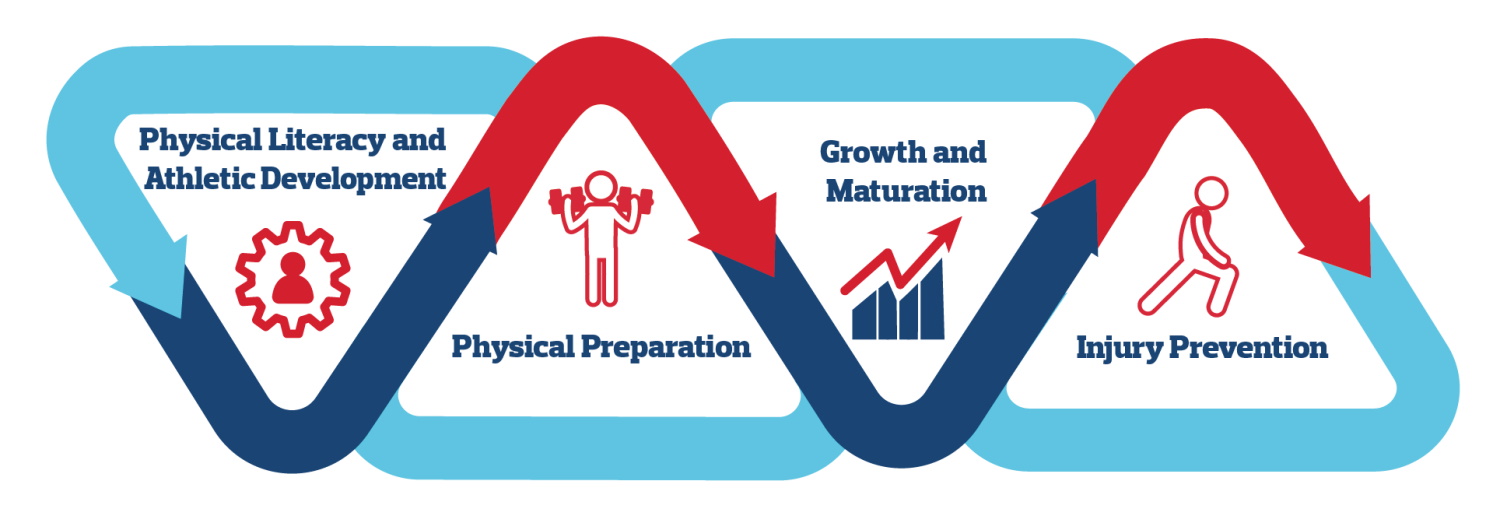
Topics covered in this guide:
The concept of athletic development is aligned with physical literacy, physical preparation, growth and maturation and injury prevention. These are the four essential components that enable participants to engage in lifelong physical activity through an integrated approach that enhances potential.
The importance of physical literacy throughout the life course cannot be underestimated: the adage from cradle to grave is very true. From our first steps through to eating, holding a pen, water safety, riding a bike and playing sport, engaging in physical activities such as walking, dancing, and life activities like carrying shopping and posture; through to getting in and out of a chair in our later life, motor learning and physical literacy underpins these moments, life events and opportunities.
The journey
Whether playing with friends, participating in a community sports activity, walking with family, carrying out household chores, progressing through a talent pathway in a chosen sport or delivering on the Olympic stage, we need to be able to move efficiently and effectively.
The journey will always be general movement, progressing to related movement through to specific movements; however, each of these components can be developed alongside each other and considered based on the stage of development and previous experiences of the participant. In the early stages of the development journey, general movements will be the main focus, while the related and specific movements will play much smaller roles. This manipulation or focus of ‘emphasis’ is the key tool in the coach’s toolbox.
This process is not linear: you don’t need to have a full movement vocabulary before you start to explore other movement challenges (although having some physical competency does help).
The aims of the journey are the:
- development of sound ‘movement vocabulary’ through high-quality development and coaching interventions
- observation (and elimination) of poor movement patterns that will lead to injury
- appropriate progressions to progressively increase the frequency, intensity, duration and load of training and competition (technical, tactical, physical and mental demands).
Development of all areas is crucial to ensure a positive experience regardless of current level, experience and progression (performance level).
Everything starts with movement.
When an individual arrives at a session, you must consider their journey, lived experiences, sporting opportunities (training age) and prior knowledge; no two people’s journeys are alike.
Development pathways need to consider the wider sporting and general physical activity environments participants work within, including home (parents, siblings and immediate family), schools, universities, clubs, community organisations and potentially talent pathways, considering their training history, coaching interactions, relationships and development opportunities/ experiences, at each stage of their journey and development.
Physical Literacy and Athletic Development
The benefits of a physically literate population include individuals who are confident and physically competent to participate in a wider range of everyday tasks, sports and activities, and ultimately able to access a wider choice of sports or activities. This aids the reduction through drop-out of practice and training, aids better transitions, and participation in new sports throughout the life cycle.
This in turn assists in the reduction of injuries and leads to increased retention, higher progression and achievement in sport and physical activity and generally happier and healthier people.
You must have a good understanding of athletic development to ensure that you can meet the individual needs of the growing and developing participant, remember, development is not age-related and continuous across the lifecycle. Motor skills and movement are at the very core of sport and physical activity, and through a progressive and challenging programme participants can develop the movement vocabulary and physical capacity to progress.
Physical literacy and athletic development provide the foundations for:
- healthy and lifelong participation
- an active lifestyle
- general well-being
- the ability to perform everyday tasks
- progression and high-performance sport.
They are an essential aspect of any balanced and holistic coaching programme.
The foundations of movement underpin all sport and actions, in every movement.
Following a systemic review and consultation, Sport England published ‘Positive Experiences for All’ in 2023. The consensus statement for physical literacy identified the relationship between movement and physical activity throughout the life course. The statement identified five key statements:

Understanding physical literacy: Physical literacy refers to the degree to which we have a positive and meaningful relationship with movement and physical activity. It is a complex and ever-changing relationship.
It reflects our connection and commitment to movement and physical activity, influenced by various factors such as our thoughts, feelings, engagement, and experiences.

Why physical literacy matters: The quality of our relationship with movement and physical activity profoundly influences our choice to be active.
Having a positive and meaningful relationship with movement and physical activity makes us more likely to be and stay active, benefiting our health, well-being and quality of life.

Supporting physical literacy: How we move, connect, think and feel during movement and physical activity plays a crucial role in shaping our physical literacy.
By doing activities that we enjoy, find meaningful, and value, we deepen our connection with movement and physical activity and foster an ongoing commitment to maintain an active lifestyle.

Our experiences affect our physical literacy: The people we interact with, the communities we are part of the culture we experience, and the places and spaces we move in, powerfully influence our physical literacy. These influences may be positive or negative.
Positive experiences of movement and physical activity that meet our needs and support our development encourage us to be active in the future.

Physical literacy is personal: Everyone has their own strengths, needs, circumstances and past experiences that affect their relationship with movement and physical activity. Our physical literacy is therefore unique and changes over our lifetime.
Building blocks of physical literacy
Just as a builder ensures that they build on solid and well-prepared foundations, the same can be said for sport and physical activity.
When fundamental movement skills combine with foundation movements and fundamental sports skills, we have a physically literate participant.
Let’s explore the building blocks further.
The fundamental movement skills include locomotion, stability, object control and manipulation.
Locomotion:
- Walking.
- Running.
- Skipping.
- Galloping.
- Hopping.
- Jumping.
- Sliding.
- Crawling.
- Walking backwards.
- Leaping.
Stability:
- Static balance.
- Dynamic balance.
Object control/manipulation:
- Self (climbing, pole vault, forward roll, sidestep).
- Others: team members (wheelbarrow race, line out, tumbling).
- Others: competitors (Judo, rugby tackle, handball).
- Use of an implement (hockey stick, golf club, canoe paddle).
- Sending.
- Receiving.
- Bouncing.
- Catching.
- Dribbling.
- Fielding.
The foundation movements are squat, lunge, push, pull, brace, rotate, and hinge. It’s crucial to develop the ability to perform these in every direction, across the three planes of the body, gradually increasing the complexity, control and speed.
The foundation movements provide the basis for all movement and support and are a bridge to the ‘related’ areas of physical development. They can be progressively developed to increase capacity, whilst the focus must remain on the quality of the movement and participants’ form. As a general rule, if they lose the form, you need to adapt the activity.
Providing stretch and challenge
The increase in the number of times they perform the activity (reps), the frequency that they perform them between recovery (sets), and the complexity of the movement, are all examples of how a coach can adapt (turn it up or turn it down the level of challenge) an activity to meet the participants’ needs.
Here's an example of push progressions and adaptations.
Push up:
- Push pass with a ball.
- Standing and leaning against a wall to perform a press-up.
- Press-up on knees.
- Full press-up on the descent, knees on the floor for the ascent.
- Full press-up with a pause on the floor to reset.
- Full press-up.
- Wide grip press-up.
- Explosive kneeling press-up.
- Explosive press-up.
The progressions for each of the movements enable you to adapt and change the activities to meet the individual’s level of development.
Progression for sports and physical activity must include the complexity for the activity. The combining of different movements and actions to gradually increase the chaos to replicate the competition or challenge.
The sequencing of movements can begin with relays, develop into games and become incorporated into technical and tactical aspects of your practice. Examples may include:
- three jumps before turning and racing through a gateway
- the introduction of a roll into a balance before regaining feet and racing to ‘win’/secure a ball.
Additionally, squatting with different foot positions, with different depths (big – small) and different speeds (fast – slow) can enable your participants to co-create a routine or matrix and share it with their group. Ask the participants to link and consider the physical activity and movements and how they can recreate them within the pattern or puzzle they create for themselves and others. This is the creation of movement puzzles, challenges and games where the participants find the solution.
Layering on the challenge, complexity and chaos!
It’s important to remember that revisiting previous progressions, sometimes referred to as regression exercises is important when participants are returning to activity after a prolonged absence, injury or as they become older, through the life stages.
The development of fundamental skills within a game-based concept such as invasion, net, striking, wall or fielding games that are modified or adapted is an essential stage of exploration, decision-making, and understanding rules and sporting etiquette within a multi-skills setting before specific sports skills. Exposure to a wide variety of activities, through which the individual finds the solution, adapts movements and makes decisions, provides a strong base for progression.
A stage of development that is often ‘missed’ or accelerated to accommodate sports-specific activities is including modified and adapted games. This unbalanced approach can often leave gaps in a person’s physical literacy. Many sports organisations now advocate multi-skill and variations of the senior game within their development pathway to ensure wider experiences and opportunities for all.
Fundamental sports skills are the application of running, jumping, throwing, catching, kicking, and hitting within a sporting context, which includes decision-making (often thought of as the technical and tactical development of skill).
Consider a cricketer running to stop a ball reaching the boundary: they combine locomotion, object control, coordination and possibly a hinge, lunge or squat action to collect/dive/block the ball, as well as the throwing action.
As a coach, you can create games, activities and challenges based on:
- the starting position of the participant
- the speed and direction of the ball
- the positioning and direction
- the outcome (stop the boundary, field the ball, attempt to throw for a run out).
They all require foundation and fundamental movements to underpin the technical and tactical decisions, which can be developed through a range of multi-skill activities and a multi-sport approach to development.
This can be through the inclusion of other sports as alternative sessions or activities within your practice session.
Sport-specific skills include the actions, skills, postures, decisions and positional requirements to fulfil the sport. They require a combination of:
- physical capacity: muscular-skeletal, neuro-muscular, metabolic capacity.
- cognitive ability: how we interpret information [perceptual], how we learn to move [action], how we acquire new skills, how we apply the skills together within competition.
This is the cornerstone of sports and physical activity participation in early life and a guarantee of involvement throughout the life cycle.
Mistakes can occur when we allow external influences and factors to have too great an impact. It is often short termism, such as winning, progressing up the rankings, achieving selection, coach ego and ambition, fixture lists/calendars that cause the stressor that creates the development ‘gap’, but as long as you learn from these experience they will, hopefully, revert to a seamless journey.
The developing child (and adult) manages a range of development domains that are all interrelated as they develop their physical literacy. As a coach, we must not remain ‘locked on’ one area of development to the detriment of the others; it’s important to create space and time to develop all within our coaching practice.
The coach must become a ‘generalist’ in all areas as opposed to being a ‘specialist’ in one area, challenging our participants to put their body in the right place at the right time, consistently.
Earn the right to progress.
Kelvin Giles
Improving athletic development
A holistic approach to athletic development incorporates factors such as technical competency and appropriate developmental stage and considers maturation and training age to describe the long-term journey of athletic development.
The challenge for you as the coach is to understand how these factors align, impact and inform one another.
How are they integrated into your coaching practice over sessions, phases and years to allow the use of a variety of training approaches to develop multiple components of physical preparation and conditioning simultaneously throughout childhood and adolescence, and through to adulthood and the maintenance beyond?
Direction, plane, speed and complexity develop along a continuum that places the individual at the centre.
Crucially, regression is as important as progression along the continuum. Your ability to ‘turn it down’ is just as crucial as the ability to ‘turn it up,’ as individuals hit growth spurts, incur injuries, and have time away from practice.
The golden rules are:
- Never progress beyond the movement pattern capability; if they are losing form, they are losing technique.
- Never load a poor movement.
- Physical competence, the ability to move fluidly and well, must always be prioritised before speed, pressure and fatigue.
Physical Preparation
Consider the reason for developing physical capacity within your programme. It requires a shift in your thinking and a holistic approach to development. The quotes below highlight the change in thinking and approach to developing a physically prepared participant.
Shifting it from a mindset of that’s a sprint drill, that’s a sprint exercise, to speed as a skill that needs to be maximised for the development of playing the sport better.
Understanding that these are physical skills that scaffold the sports skills and develop the capacity to consistently perform well.
It's understanding what physical elements a participant needs to thrive within their sport, but that by playing the sport you are not going to develop them.
I need to be strong to handle the physical contact of the sport, but playing in principle is not to increase my strength. If anything under a lot of playing time, my strength will be reduced.
Simple fundamental warm-ups, are good holistic movement opportunities and if you don’t ‘use it you lose it’…. It gets them incrementally better.
Strength and aerobic capacity
As our participants develop, their movement capability improves, their physical form can be maintained and they can cope with increased demands (speed, decision-making), there is the need to add and experience different qualities of force.
So, what is force? As a real-world example, it’s the ability to deliver a lot of energy into an object quickly. In the case of a sprinter, they are delivering the force into the ground and repeating this over and over. For many sports, it’s not about jumping high or far, it also requires a participant to jump fast. A cricketer throwing a ball and a footballer striking a ball require a combination of strength and speed.
When we stand up on both legs, we have half our body weight on each leg. If you then stand on one leg, that’s 100% of your body weight on a single leg. Then let’s consider that we move in a variety of planes, and have to accelerate and decelerate, which can add further stress (+50% of our body weight). This creates a huge amount of stress, which impacts bones, tendons, muscles, cartilage, and the ligaments that support every step we take.
Sport and physical activity take place in an ever-changing and dynamic environment: the surfaces change, the decisions change, we change direction, change speeds, change tempo, must speed up and slow down and in many sports, we need to factor in an opponent! We need to prepare the body to be able to cope with these demands.
These journeys now begin to run in parallel. As the movement journey is being progressed, so too is the strength journey. The journey will need to include adaption and progressions from general to related and finally into specific aspects.
Introducing strength from maximum through to reactive strength (applying strength in an activity) before developing in complex and multi-directional combinations, variations and progressions.
Consider this example of a runner. Once they have developed a consistent running movement pattern (mechanics), the coach begins to introduce and progress the strength journey in parallel. They introduce the squat and lunge matrix to create the ‘force’ elements required by the running mechanics patterns.
Squat and lunge matrix: Participants move from one movement to the next maintaining control and form.
- Shallow squat.
- Body weight squat (90º angle at the knee).
- Full depth squats (thighs parallel to the floor).
- Shallow squat to calf raise.
- Body weight squat to calf raise.
- Full depth squat to calf raise.
- Staggered stance.
- Lunge number.
- Lateral lunge.
Aerobic capacity (often referred to as metabolic capacity) is the body's ability to effectively absorb oxygen and circulate it through the blood to the working muscles. Metabolic capacity has a significant influence on your overall level of fitness.
The same decisions, adaptations and progressions can be made for the metabolic journey, adding a further parallel journey, developing all physical capacities at the same time.
Key point
The strength and metabolic journeys must never accelerate beyond the movement pattern capability. Maintaining form and technique should always be the priority.
Whether developing the journey of running, jumping, throwing, kicking, catching, striking or flotation, any metabolic progression must have and maintain movement efficiency and consistency as its central pillar.
The general to related to specific parallel journeys gradually emerge as the individual progresses along the journeys of speed, speed-endurance, and endurance within an acceptable, appropriate movement technical model.
The running mechanics within the specific sporting and physical activities will be different. The adaptation of posture, form and demands needs to be purposeful, such as by developing an endurance runner from a technical base using tempo running as opposed to long, slow distances where efficient running movement patterns are often lost.
The running mechanics in rugby would be different, as the need to carry a ball, use evasion to avoid players and run directly into contact are very different from those of a 100m sprinter.
Build capacity with clear knowledge of the sports’ physical demands (model of performance) and the individual participants’ needs (current capacity, training history, positional demands, experiences).
Ask yourself:
- Is there a requirement to make repeated efforts such as repeat sprint-ability? (Badminton, hockey, basketball.)
- Are there requirements to make and repeat ‘get-up-ability’ from the floor? (Rugby, MMA, Judo.)
- Is there a requirement to make repeat contact ability with an opponent? (Handball, rugby; basketball.)
- Is there a requirement for repeated throwing ability? (Bowlers in cricket.)
The most important consideration is to understand the importance of physical preparation and how it can be used not only to prevent and reduce the risk of injury but also for skill acquisition and to improve performance. It is also important to understand load management, competing demands of training and competition in different sporting environments.
Growth and Maturation
Growth is the physical change and increase in size and it can be measured. Indicators of growth include height, weight, limb length, bone size, density and muscle mass. Generally, it takes place during the first 23 years of life, whilst development will continue after that time.
Maturation is the process of moving towards adulthood, occurring from early childhood to adolescence and then to full adulthood, which occurs around the age of 23. The start of adolescence begins at the onset of puberty where hormonal and physical changes begin to occur. Rapid changes occur during this time including the development of secondary sex characteristics, height and weight.
Growing can be painful, as children and teenagers can have growth spurts (peak height velocity), where the bones grow much quicker than the muscles and tendons. They become stretched, strained, and painful.
During this time, participants need to become accustomed to their new limb length and size, they need to adapt to an increased reach and change in their centre of gravity. Add an implement such as a hockey stick, tennis racket or striking a ball and things become even more challenging. During this time, they can become clumsy as they settle into their new shape; this is often referred to as ‘adolescent awkwardness’.
Every individual will progress at their own rate of personal growth and development. The speed and time/tempo of the progress towards an adult biological state is highly individualised; however, the sequence of progressions is predictable (everyone goes through the same stages in the same order).
Maturation is independent of the environment, but its timing can be influenced by environmental factors (culture, climate, family and nutrition).
Development is a behaviour; for example, the person develops their ability to walk, talk, to run. It is an increase in the complexity of function and skill progression. A really simple example is when a younger sibling may progress faster as they simply copy and follow their older sister and/ or brother’s example.
Development combines:
- growth
- maturation
- learning
- experience.
Are you seeing potential or are you seeing maturation?
Confusing ability with maturity!
Biological maturation and performance are often seen as related in youth sport. As coaches, we need to consider what we are observing. This becomes even more important when we begin to identify and select participants for teams, competitions and talent pathway opportunities.
It’s also important to remember that we are not all born equal.
The overrepresentation of individuals born at the start of the cut-off date and the underrepresentation of individuals born toward the end of the cut-off date of an age band is termed the relative age effect (RAEs). In schools, in the UK, age is defined on an academic year (September through to August). As a result, those born in September are relatively 12 months older than those born in August. RAE is normally monitored in quarters; with Q1 being September – November and Q4 being June – August. Sports that utilise a calendar year have January – March as Q1.
Older participants playing in a two-year age band may have a potentially greater advantage, being born ‘relatively’ earlier in the band. In Under-14 sport you could have one participant aged 12 years and one day playing alongside a participant aged 13 years and 364 days, amounting to almost a two-year difference in age. Then considering the addition of maturation status of individuals, early, or late can result in a maturation status difference of four years in a two-year banded competition. This creates challenges for the participant and coach alike.
The Matthew Effect means that success comes to those who are already successful thanks to their advantages. The Matthew Effect is evident in many areas of life, including sport and physical activity.
The benefits for those selected into a pathway environment will include:
- better training facilities
- access to better coaches
- more frequent training opportunities including, training and competing against better participants
- more opportunities to compete
- enhanced training programmes
- that they're observed more often and ‘halo’ effect during future selection
- support in wider areas of development including medical and psychological support.
The Pygmalion Effect is a phenomenon in which the higher the expectations placed on individuals, the better their performance and execution of the activity or skill. In a coaching environment, if we have high expectations as a coach, combined with the appropriate support to meet the challenge, our participants will strive to achieve the expectations placed upon them.
This leads to increased motivation, belief and commitment from participants and the confidence to try new things, step forward and have a go. Participants can be more creative, daring and willing to try new things including skills and sports.
So, what does this mean for our coaching practice? Have a clear model of performance, consider all areas of development, provide clear expectations, continually affirm participants’ strengths, and focus on what they can do (rather than what they can’t). Focus on the development of the individual’s potential over the current performance. Consider buddy and role model approaches within your sessions.
Tthe opposite of the Pygmalion effect, the Golem Effect occurs when those in a position of power (such as a coach, manager, selector, or scout) expect a low performance from the participant and as such their behaviour and expectations reinforce the very behaviours that they predicted.
The impact on participants includes:
- a reduction in confidence and self-belief
- low effort
- less striving
- reduced resilience to solve problems
- lower performances.
Combat this by working to catch yourself when setting low expectations and targets. Don’t allow you or your participants to go through the motions and ensure that you’re challenging the individual through engaging and aspiring goals. Set the challenge bar high, with appropriate support.
Based on a social experiment where an individual’s own opinion about their ability and self-value influences their performance, this can be seen when a participant evaluates their ability and performance by comparing themselves against their peers and competitors. If they believe they have the potential to perform at that level, they are very likely to do so.
These effects often work in combination, further impacting on an individual's confidence, competence and opportunities to progress.
Injury Prevention
Prevention is better than cure.
Desiderius Erasmus
Physical exercise and activity are the best preventative measures when it comes to injuries, so time spent on injury prevention activities should be seen as an ‘investment’, rather than a ‘loss’ of time.
Injuries occur in four main ways:
- Acute injuries are typically caused by a single trauma accident such as a fall, collision or heavy blow. This also could be caused by not warming up properly before physical activity.
- Overuse injuries are caused by repetitive stress to bones, ligaments, tendons and muscles. Examples include shin splints, Iliotibial band (IT band) and tennis elbow.
- The use of incorrect equipment such as ill-fitting personal items and protective wear or performing poor technique.
- Working beyond your limits including physical, cognitive, and decision-making ability.
Knee injuries, strains and sprains, shin splints, dislocated joints and acute stress fractures are the most frequently occurring sports injuries, with the lower limbs being the most common.
Physical preparation reduces the risk of injury, decreases the severity of an injury should it occur, can assist in the rehabilitation process and can prevent re-injury.
Explore the 3 Es of injury prevention:
It’s crucial to educate participants about the potential risks and hazards in your coaching setting and provide tips on how to avoid them. Every setting has hazards, and participants have a responsibility and a duty to care for themselves and other participants, including their opponents.
Highlight and explain the importance of a thorough warm-up and cool-down, focusing on the quality of movement. Role modelling the importance of this can also be impactful, but be sure to explain the ‘why’, not just the ‘what’ and ‘how.’
It’s also a good idea to connect activities to prevention and highlight that this is an important aspect of preparation. Coach and reinforce appropriate and safe technique and make it clear that using breaks and rest periods can reduce injuries and heat/dehydration injuries.
Environment refers to the specific coaching environment. It's related to education in the sense that both require an explanation to participants about risks and hazards.
This includes having the appropriate training and competition clothing and safety equipment and how they conduct themselves around the facility and venue.
Examples include:
- Induction to new facilities.
- Putting away weights in the gym.
- Walking on the pool side.
- Wearing shin pads.
- Remembering to bring their gum shield.
- Taking responsibility and checking their area when training for anything left accidentally, especially in public areas. Explain that you have ‘swept’ the area, and further highlight that they should check again.
- Ensuring that post protectors are in place.
- Safe run off areas around playing surfaces.
- That they have an adequate space between activities.
This is simply ensuring that your participants arrive appropriately prepared and follow the agreed rules.
Make sure to role model their importance by including injury prevention within your sessions and highlighting the benefits and why. Whilst difficult, this may require a participant to sit out if they don’t have the appropriate equipment to participate safely. The individuals' safety and well-being are always the first priority.
Safety first, safety last, safety always.
Rehabilitation
Injuries are an unfortunate likely eventuality of sport and physical activity. Even with a thorough programme design including warm-ups, cool-downs, physical preparation and injury prevention exercises, most individuals will experience having to take time away from practice and competition while they heal and repair.
This can be a frustrating and difficult time and is often as challenging emotionally and psychologically as physically.
When considering rehabilitation, it is often beneficial to the individual to remain in contact with you and the group. The feeling of social support, regular interactions and remaining a member are important to many people. For others, watching their teammates and training group is a further challenge, reminds them of what they are missing and can have a negative impact on their mental well-being. Rather than having fixed rules for rehabilitation and return to training, apply the same principles to the rest of your coaching and put the individual at the centre of the conversation and decision.
Scope of practice
How often have you been asked if you can provide guidance about an injury or for exercises to help with an injury?
Rehabilitation often involves an inter-disciplinary approach, with input from healthcare professionals such as physiotherapists, doctors and exercise professionals with an understanding of injuries, medical conditions, and the body's physiological responses to exercise and treatment as they gradually return to training and competition
Attempting to diagnose or treat injuries beyond your expertise or qualifications can result in inappropriate or unsafe rehabilitation methods that may delay recovery, exacerbate the injury or potentially cause further harm.
It is crucial that you operate within your scope of practice to ensure the safe and effective rehabilitation of participants and collaborate effectively with these professionals in designing the rehabilitation plan that prioritises health and well-being.
It is your role to:
- work closely and communicate effectively with healthcare professionals. This may include signposting to medical practitioners.
- adapt the participant's training programme based on the rehabilitation plan and medical recommendations.
- provide support and encouragement to help the participant stay focused and positive during the recovery process.
- facilitate the transition from rehabilitation through to return to play and competition in consultation with the healthcare professionals.
Coaching through the rehabilitation process
The biggest indicator of an injury is a previous injury.
The rehabilitation process is a continuum with no fixed date to return to ‘normal’ and is different for everyone.
Understandably, injured participants can become frustrated and want to get back to ‘normal’ quickly. The danger of returning too soon is that they may reinjure themselves, and create further problems, sometimes seriously.
Equally, being isolated from the training environment can be emotionally and psychologically challenging and demotivating, and the removal of their teammates and training partners – a key component of the social support – can have negative impacts. This will vary for the individual and duration of the injury.
For some participants, simply being around the sessions, and mixing with their peers, helps them feel connected and valued and has a positive impact. For others, being side-lined watching others progress and compete can be very detrimental. Finding the right approach for the individual is required to aid the healing process and get better.
Taking the time to ensure that injured participants feel included and motivated is beneficial for them and the team and can increase the likelihood that they will return to sport or physical activity more quickly. Many coaches consider injured players to be another pair of coaching eyes and encourage them to support their peers during coaching sessions. The introduction of coaching styles including reciprocal coaching can be extremely beneficial for all concerned.
Advice developed in partnership with Head Coach at Excelsior Athletic Development Club James Marshall includes modifying tasks to enable them to participate in sessions.
Coaching an injured participant, or a participant coming back to sport or physical activity after an injury, by looking beyond their current capabilities and including them in your sessions, may mean that they return to training and competing quicker than if left out.
You might want to consider that:
- a person's identity is often wrapped up in their role in the team; they perceive themselves as 'an athlete.' An injury takes that away, so they may be feeling vulnerable and excluded
- greeting the participant and taking an interest in their well-being and welfare is sound coaching practice. Continue this when they are injured
- some participants may hide the severity of an injury to be selected. There is a difference between training when sore and tired, and training when injured. You should help participants understand this and encourage them to never train through pain
- concentrate on what the participant can do rather than what they can't do. Many tasks can be modified, such as using the other arm or leg
- if the participant has a severe injury that prevents modified team activities, they can do their rehabilitation in view of their teammates rather than in a separate area. Maintaining a connection with their peers is crucial and feeling included, involved and cared for is the key
- boredom and frustration can lead to negative behaviours, so think positively about how to include them in sessions. Bib collecting and filming may seem like punishment if that is all they are asked to do
- keeping parents or carers (if appropriate) and medical staff updated is important
- if you create a welcoming and supportive environment, then parents or carers and medical staff may be more likely to allow the participant to attend training sessions. That reinforces connections and supports the participant.
Keeping connected with your participants and showing an interest in them as a person, their injury (status) and return to play will help them feel valued and part of the group. They will also find this motivating and help them focus on their return to training. Just because they are unable to practice doesn’t mean you are not their coach, make extra effort to connect and communicate with injured participants.
Encourage them to attend your sessions and be positive in how you approach this:
- What can they do?
- What can you adapt in the session?
- Which area of development could they work on during this time?
- Consider and respect that it may be too soon or frustrating for them to watch others train and whilst your invitation is well-meaning, they may not be ready.
It’s important to consider that there is rarely a clear injured or non-injured status. Often, different ‘levels’ of return to sport or physical activity will be appropriate, depending on the severity of the injury and the nature of the sport or activity.
When working with participants under the age of 18, it's important to speak to their parents or carers when returning to injury. A younger participant may not be aware of all the information provided by the healthcare professionals when they are discharged, or may choose to ignore the advice in an attempt to return to training quicker. Education and explanation are important conversations in the coach's kitbag.
Asking these questions, both of yourself and the medical professional with experience in the case, will enable you to clarify exactly what the injured participant can achieve at each stage of their recovery.
Asking the right questions will also help you develop as a coach. Experience in this area can inform your coaching practice going forward.
Returning to training, play, and competition
Returning to sport and physical activity following injury and rehabilitation requires careful consideration and planning to ensure that the individual is ready physically to progress and resume the activity.
Sports Physiotherapist at Regeneration Physiotherapy Group, Curtis Taylor created this handy return to play visual for you to use and share with your participants (and their parents or carers) to ensure that when individuals return to play, it is at the correct time for them.
Return to play should ultimately be dictated by:
- pain-free, full range of motion
- equal strength compared to the uninjured side
- elimination of bruising and swelling
- equal balance compared to the uninjured side (if it is a lower-body injury)
- no residual walking gait deficits.
Depending on the type of injury, it can take a few weeks or months to make a full recovery. While recovering, it's important not to do too much too soon: aim to increase your level of activity gradually over time. Remember if they are not training they will have physically regressed, and you will need to reset their current level.
When managing any return for injury, pain, or rehabilitation you should:
- always consider the long-term health of participants as the priority
- hold regular discussions with the participant (and their parents or carers where the participant is under 18) about appropriate activity and levels of activity when returning to training, play, and competition
- follow the guidance of appropriately qualified professionals such as a GP or Physiotherapist and seek this in writing if appropriate
- follow a graduated return to activity following a concussion or head injury, including educating participants about the dangers of concussions, and how to recognise if someone might have one
- not allow participants to return to full activity before they have fully recovered from injury
- not allow participants to train, continue with activity, or compete when they are concerned about potential concussion, pain, or injury, or when they show clear signs of distress and/or pain
- continue to monitor the individual closely as they reintegrate into training and the intensity, physicality and load increase.
Related Resources

Athletic Development and Physical Preparation
Learn about this theme of the Coach Learning Framework and discover its key pillars to learn how to develop and enhance athletic development
LEARN MORE
Coaching Conversations
Watch coaches share their lived experiences, offering real-life examples and strategies to help you immediately develop and grasp the theme of ‘athletic development and physical preparation’, enhancing your participants’ physical literacy
WATCH THE VIDEOS
Kickstarter
Download activities that invite you to reflect, consider, and try out new approaches that will help you design programmes to enhance strength and conditioning, prevent injuries, and support recovery
DOWNLOAD THE ACTIVITIESUK Coaching Club Premium Membership


