
Understanding Your Coaching Practice Guide
 Article
 by UK Coaching
With this comprehensive guide, you'll explore what is and isn't in your control, and how to create high quality, holistic learning opportunities for all

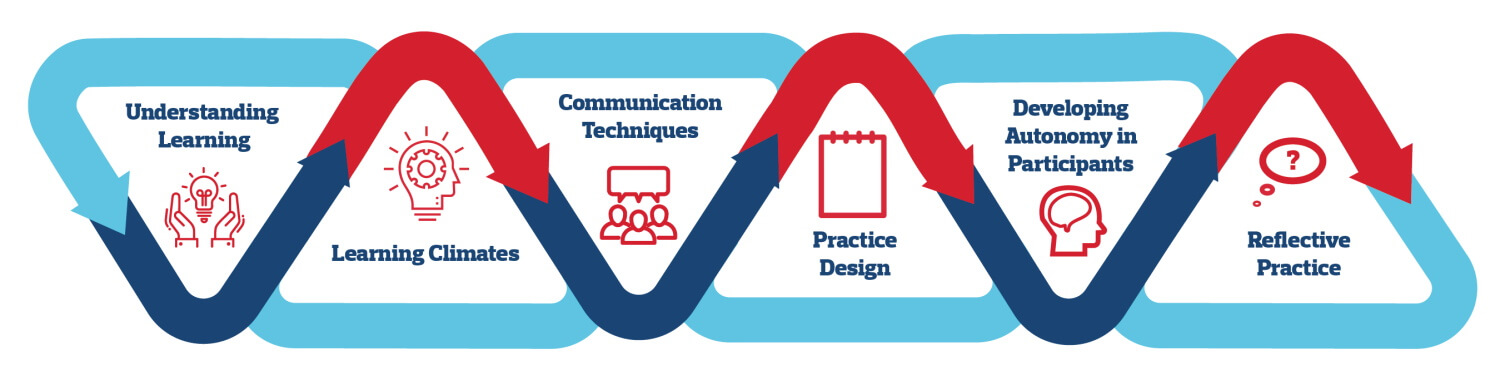
Topics covered in this guide:
In coaching, there are only two things fully within a coach’s control:
- the programmes, sessions or practices planned
- the behaviours that the coach chooses to present to the participant(s).
These combine to make up your coaching practice, so it makes logical sense to focus on these to ‘control the controllables’.
This guide will introduce you further to the key components that sit within coaching practice and link you to further learning to enhance your coaching.
As to methods, there may be a million and then some, but principles are few. Those who grasp principles can successfully select their own methods. But those who try methods, ignoring principles, are sure to have trouble.
Harrington Emerson 1911
Understanding Learning
Learning is a process of acquiring, developing, or refining new knowledge, skills or behaviours. The impact of learning lasts a long time and potentially a lifetime.
Learning is a complex concept. Complexity can be thought of in terms of there being:
- low levels of agreement on what the correct methods are
- low levels of certainty on whether applying such approaches will lead to intended results.
For example, raising two children in a seemingly consistent way within the same household can lead to very different outcomes in some cases!
This is because humans are complex beings who respond differently and sometimes unpredictably to situations. The matter is complicated further by sports and physical activities, many of which are also complex in the way they are played and the unique problems that they constantly pose.
Consider coaching a young hockey player to attack 1v1. This requires, among many things, an understanding of learning (how), the participant (who), and the sport of hockey (what).
You also need to recognise that there is a near limitless range of potential ways of successfully beating the opponent and what works in one situation against one opponent is not guaranteed to work in another situation against a different opponent. Complex!
- Player uses speed to beat the opponent.
- Player uses their body to shield the ball.
- Player uses dribbling and stick skills to beat the opponent.
- Then they can add these together and adapt each one!
This pillar is designed to help you gain a better knowledge of the processes that are involved in learning and what variable aspects of your coaching may impact it.
Participants need to have the motivation to learn above anything else, so understanding your participants as people and their wishes within the sport or physical activity can go some way in enabling learning to happen. Progress, success and believing you are competent and having a belief that you can achieve something are very powerful motivators.
The perception that participants have of themselves is a major factor in their ability to learn. Coaches can influence those perceptions that individuals have of themselves, which is sometimes referred to as ‘self-efficacy’.

Self-efficacy
This is the judgment a participant has about how well they think they can cope with a specific challenge, and it is a strong predictor of success in a particular situation.
It is affected when participants experience success and is one reason why participants of similar ability and experience can perform wildly different in some situations; they may have approached the situation with different levels of self-efficacy.
It is not about the situation itself but more about how a participant perceives the situation and what they expect to happen that determines their behaviour and the outcome. Therefore, self-efficacy is ‘domain-specific’.
For example, it is no guarantee that a triathlete who has only ever competed in a pool will approach an open water swim with high levels of self-efficacy. The more competent, experienced, and familiar a participant is with their sport or activity, the better they can determine if they can deal with the challenges they face. This is why the type and level of challenge that the participant is faced with is crucial for their development and learning.
When participants have high self-efficacy, they’re more likely to take on a challenging task. They are also better able to deal with failure as it will have been recognised as a learning opportunity and a means to eventual and longer-term success.
Mastery of a skill or task leads to a perception of success and therefore helps the participant to feel more motivated to continue investing effort to learn. It helps the person gain more ‘stickability’. A virtuous cycle.
Principles of self-efficacy and tips to help your participants develop:
- Performance accomplishments: successfully overcoming challenges and tasks is a powerful motivator so ensure you pitch the challenges appropriately.
- Vicarious experiences: watching others succeed, especially those of similar or lesser ability, is a powerful motivator to learn.
- Verbal persuasion: letting a participant know that you genuinely believe they can overcome the challenges faced.
- Emotional states: help your participants into a positive state before taking on challenges through conversation and showing you trust and care.
There is more than just sell-efficacy that influences a participant's investment of effort to learn. What they attribute to their success or failure is just as important.
Attribution theory
Whilst self-efficacy is about how a participant perceives a situation, attribution theory is what a participant thinks is the cause of that success or failure. It considers how those perceptions impact the participant’s emotions and it can influence their motivation to continue learning. Just like self-efficacy, it is the perception that is more important than the reality.
Three interacting aspects go towards explaining success or failure:
- Internal/external: success or failure was thought to have been caused by something within or outside of the participant.
- Stable/unstable: how likely a participant believes the same outcome will be achieved next time.
- Controllable/uncontrollable: the degree to which something is thought to be in the participant’s control.
Here are some examples:

High achievers are those people who have been able to learn relatively better than others, and as such tend to attribute success to internal factors and failure to external factors. Low achievers tend to do the opposite.
How a participant responds to success or failure and what they attribute that to then leads to an emotional response that impacts self-efficacy and their beliefs about future performances. This will then impact on their capacity to take on and learn from further challenges.
Performance outcome --> Reaction (+/i) --> Attribution --> Emotion --> Impact on self-efficacy --> Impact on future performance
Here are some examples of how to use these in your coaching:
How well a participant believes they can cope with a challenge.
- Appropriate challenge, with appropriate support. Set tasks and challenges for the participants with a realistic chance of success via effort. Not too easy or too hard.
- Say what you want to see. Link back to prior sessions and/or knowledge and be clear about what success for a particular task looks like.
- Link it to the sport or physical activity. Relate the tasks to what the participant can already do and explain why they are doing it.
- Practice for the competition or activity. Try to give your participants challenges and tasks that are realistic and representative of those they experience in the competition so that they learn how to cope with the emotions that come with it.
- Say what you want, not what you don’t want. Feedback on progress rather than just mistakes.
What a participant thinks causes success or failure.
- Reward the effort and connect this with the achievement, say why they did it! Try to consistently link success to effort wherever possible. This is more within the participant's control than any other factor.
- Be realistic in your feedback and aspirations. Don’t give your participants false hope of what they can achieve with maximum effort.
- Take time to talk. Find out what your participants believe about and attribute the outcomes of their performances to and work with them to shift their perceptions accordingly.
- Always person before participant. Recognise the emotional state that the participant is in after a performance and how it impacted their self-efficacy. Key markers of guilt or shame after failure may indicate internal factors, whilst luck or gratitude after success could point to external factors.
Learning Climates
Where you are, it may be sunny, raining, or perhaps windy. It is observable and measurable. Climate, however, is associated with a weather pattern over a longer period of time. If somebody asked you to describe a tropical climate, you would likely say it was hot and humid.
In coaching, a climate for learning could be described as the social, emotional and physical conditions that enable learning to happen. It is how the participant perceives (sees, feels, hears, thinks) the environment and is created by the interaction between the participant, coach and context (the circumstances that surround the coaching, such as time, place, sport, or activity).
The climate a coach creates can influence how participants feel about themselves and their sport or physical activity.
Anyone who has tried to grow their own fruit or vegetables will have realised that some varieties flourish in certain climates better than others. Participants tend to thrive in positive learning climates whilst a negative climate in your coaching could have adverse and unexpected consequences.
Here are some questions that might point towards indicators of a healthy climate for learning.

How often do the participants you coach:
- interact positively with you or each other?
- ask you or other participants questions for help, understanding or clarity?
- share ideas or opinions with each other or you?
- support each other or you?
- offer feedback to you or each other about what they like or can be done better?
- help each other or you?
- see mistakes as opportunities to learn?
It is your responsibility as the coach to help create a climate that maximises the learning potential. But how can you do that? To create a climate for learning, learning should be at the centre, and this needs ignition and drive to learn from both participants and the coach.
The interaction between our coach behaviours, coaching practice and approaches, and communication, all influence and affect the climate. Consider a coach who says they would like everyone to improve and get better, playing an ‘open’ style. However:
- they select on performance rather than effort
- they substitute a participant for making a mistake that results in the team conceding a goal
- they show angry body language when someone makes a decision they don’t agree with.
Are these behaviours and approaches creating a learning environment and openness to try new things? The difference between words and actions is very important.
One approach when considering the coaching climate could be through ‘task’ and ‘ego’.
- An ego climate is the regular placing of importance and success on being better than and beating others, regardless of effort or personal improvement.
- A task climate is one where importance and success are placed on the development of skills, progress and effort.
No climate nor individual is completely task or ego and things can change over time but here are some potential indicators of both:
- Regular engagement.
- Giving the best effort.
- Persistence through hard times.
- Taking on difficult challenges.
- Working at improving areas for development.
- Everyone feels they have an important role.
- Not giving the best effort.
- Worry about being good enough.
- Regularly choosing easier challenges to avoid losing or to guarantee success.
- Only participating in activities and sports that they believe they will be successful in.
- Giving up easily.
- Unhealthy rivalry between team members.
It isn’t as straightforward as one or the other in some circumstances though. For example, many sports or physical activities have a limit on the team or squad size which can then create a natural competition for places between participants. The coach might consider how they can reframe this into a more cooperative environment.
How participants have perceived their climate has also been linked with the following:


In summary, the climate for learning is heavily influenced by the coach and is built upon strong, positive relationships.
Consider adding another layer to your thinking of task/ego climate. Introduce approach or avoid. You may recognise where and when these have been used in your coaching.
Approach
- Task: Focus is to improve on a personal best or learn a new skill.
- Ego: Focus is to be the best or score more than anyone else.
Avoid
- Task: Focus is not to do worse than a previous performance or score.
- Ego: Focus is not to be the worst performer or do worse than another opponent.
How you frame elements within your coaching programmes and practices may fall into these four categories and by being more aware of how you currently coach, you can start to shape the climate.
The TARGET framework can be used to consider how to shape the climate:

Communication Techniques
We know that effective communication is crucial to developing and strengthening relationships. It’s also vital to the technical and tactical aspects of your coaching programme.
Understanding that the way you engage and communicate with your participants can significantly impact their overall development and has the potential to either foster positive holistic development or lead to confusion, frustration, poor performance, limited growth and withdrawal is essential.
Effective and supportive coaching behaviours are essential for creating an environment in which participants feel empowered, motivated, confident in their abilities, and can thrive.
There are many ways in which you communicate in your coaching practice, including through:
- feedback
- instructions
- questioning
- listening
- modelling or demonstrations.

Feedback provides essential information to participants about their performance, progress, and areas for improvement.
You will be required to provide feedback and guidance to your participants about a variety of areas including:
While positive feedback can reinforce desired behaviours, constructive feedback offers suggestions for improvement (importantly) without being overly critical.
Constructive feedback is a vital component of a thriving environment, that provides clear, and concise messaging ensuring that participants understand the specific areas they need to work on and the steps they can take to enhance their development.
Feedback is a crucial aspect of learning and development, extrinsic feedback from a coach provides information for error correction and refinement, positive reinforcement to the individual, motivation to continue and improvement of performance. Feedback provides the foundations to self-awareness, realistic performance evaluation and autonomy for participants as they develop the ability to reflect on feedback and use internal feedback to progress and develop.
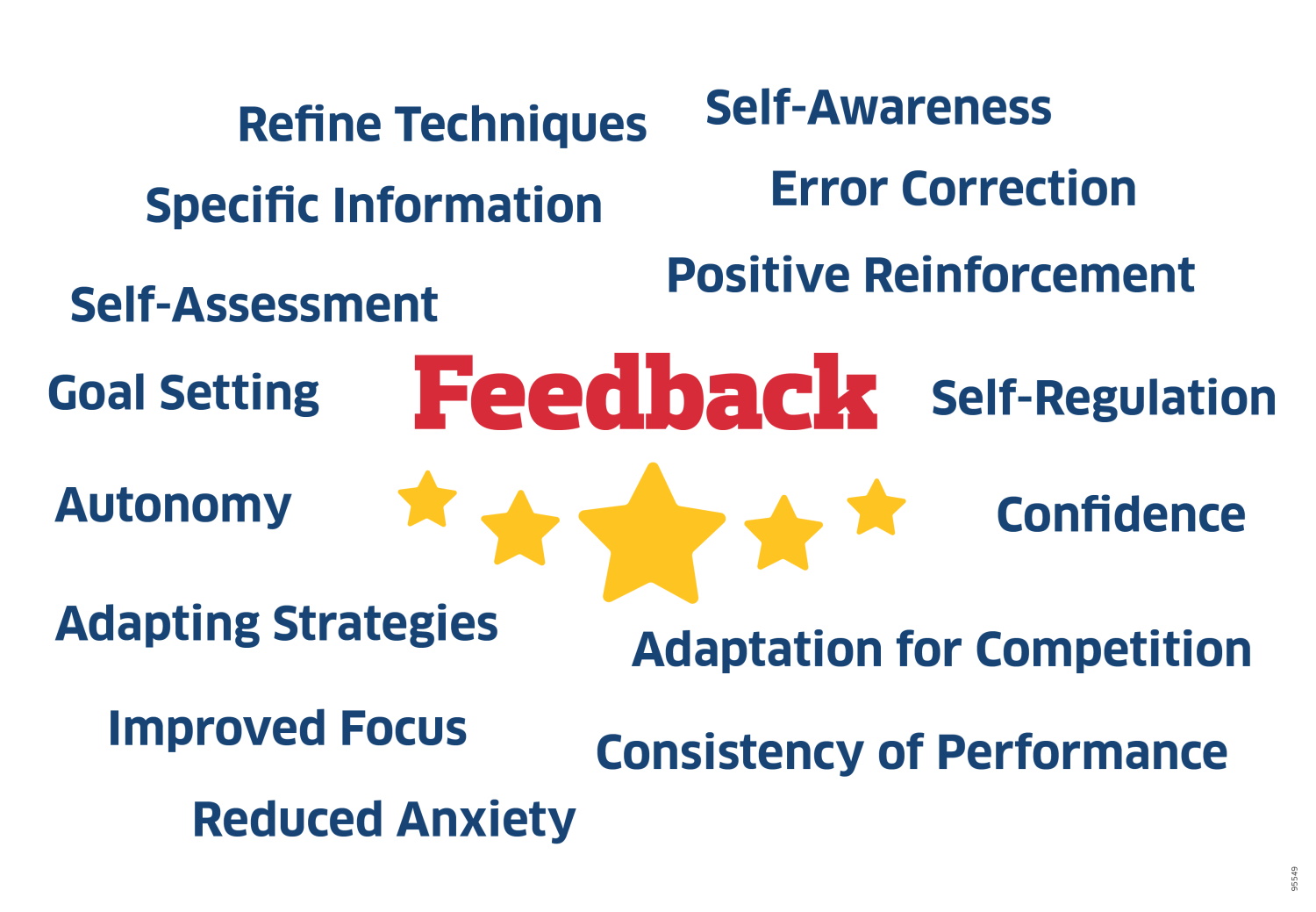
Two approaches that are essential in your toolkit are fading feedback and bandwidth feedback.
Fading feedback
Fading feedback is an approach where there is a gradual reduction in the frequency and intensity of feedback provided to participants over time. The purpose is to raise participant’s self-awareness and increase their responsibility for the improvement of their performance as they become more independent.
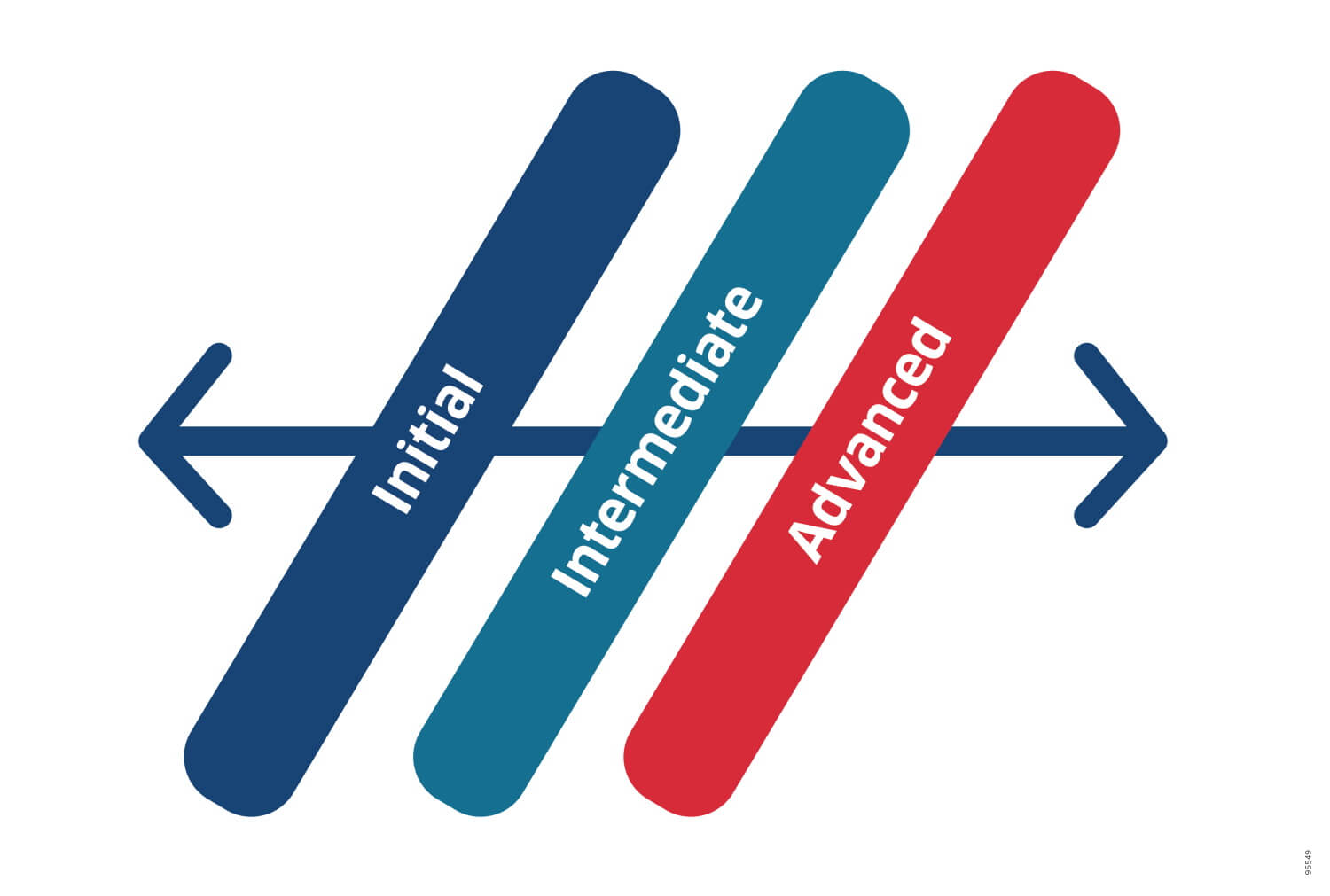
The Initial stage is used when a participant is new to the experience. This may be the introduction of a skill, an environment they are new to or that they are experiencing the decision-making and strategy for the first time. The feedback is detailed, frequent and immediate to enable the participant to acknowledge, connect the feedback to the error and quickly adapt and make adjustments.
The Intermediate stage is used when participants become more confident and proficient in the skill or area of development. The feedback is gradually reduced as the coach no longer feeds back on every attempt or approach, feeding back less frequently after several attempts. The feedback is focused on specific areas of refinement and aspects to consider rather than the whole skill or decision-making process. They provide space and time for the participant to internalise and provide their own feedback, refinements and adaptations.
The Advanced stage is used when only major errors occur or the individual requests feedback from the coach. This encourages the individual to take responsibility for their own development and feedback as the participant identifies and uses internal feedback to progress and improve.
Using fading feedback creates the conditions during practice and competition where the participant develops their ability to reflect upon and correct their performance as they navigate the journey to being independent. As the individual is required to retrieve and recall information, as well as apply this in the current situation as it evolves, this improves retention under pressure and in different situations. Participants perform in competition on their own, so this approach allows the coach to prepare the individual for this and reduces their dependency on the coach. This is a development beyond the behaviour or looking to the sideline, or seeking direct feedback from the coach.
Feedback is the breakfast of champions.
Ken Blanchard
Bandwidth feedback
Bandwidth feedback is an approach which allows you and your participants to feedback based on what you have agreed is an acceptable range (bandwidth) of tolerance or focus (performance outcomes). It’s important to agree and share the bandwidth of feedback to participants as this firstly, ensures that they know the intention of the activity and secondly, helps them focus on the development area. From a coaching perspective, you are able to focus your attention on the intention of the activity or session.
Three stages of bandwidth feedback
- Agree and establish the acceptable range for feedback based on the intention of the session and performance outcomes.
- Observe and analyse the participant's performance and actions.
- Provide feedback if the actions, decisions, techniques or skills are outside of the agreed bandwidth. If the actions are within the agreed ‘corridor’ of the bandwidth, no feedback is given.
The benefits of bandwidth feedback include:
- creates a strong focus on the activity or session intention
- reduces the overload of information to participants
- encourages the individual to focus their attention on the identified aspect of the skill or activity and monitor themselves to self-correct
- provides an agreed criteria for feedback that accepts only feedback on significant errors, which makes the feedback received more impactful.
Regular use and consideration of bandwidth feedback encourages participants to be more aware of their development, independent in their evaluation of their performance and take responsibility for their learning.
Tips:
- Effective feedback should be specific, timely, and constructive to support participants in understanding what they are doing well and what they need to work on, and delivered in a manner that is supportive and encouraging.
- Praise publicly, challenge privately.
- Ask your participants about their feedback preferences to ensure that any feedback is tailored to their needs.
Clear instructions and expectations help participants know what is expected of them and how to achieve their goals which can lead to increased motivation and performance.
Effective instructions should be easy to understand, relevant to the task at hand, and provided in a manner that promotes clarity and understanding.
A picture is worth a thousand words.
Instructions may be used to provide explicit and detailed information to a participant to aid their progression or to reduce the level of risk to an activity. Instructions are primarily used to establish and set up the activity, scenario or learning opportunity and can enhanced with a demonstration. It’s important to remember that the instructions are there to prime the activity and get your participants active.
Short and sharp should be the approach: think about giving enough information so they know what to do and can start learning and developing. Make sure that everyone can see the demonstration and how the practice or activity is set up, and provide simple instructions to support the demonstration.
Consider different angles for the participants to observe when demonstrating skills and keep the coaching points to a minimum. In your planning, consider whether you are showing the mechanics of the activity; how it works, where they start and the rules, constraints or outcomes or introducing the technical components of the skill. It’s often easier to get everyone active and then follow up with individuals to refine and adapt their skills.
Tips
- Avoid using slang, jargon and technical terms.
- Ensure that instructions are tailored to the individual's skill level and learning style.
- Use simple and easy-to-understand language and instructions.
- Be brief and give participants a single piece of information at a time, breaking down complex concepts into understandable chunks.
- Provide opportunities for clarification if needed.
Questioning is a powerful coaching tool! They can help you to understand your participants, encourage engagement, stimulate problem-solving and critical thinking, and build connections.
Asking good questions is key to effective communication.
Tips
Good questions are:
- Open-ended and encourage participants to think creatively and express their thoughts and ideas. Examples often begin with Who, Why, What, When, Where or How.
- Nonjudgmental and empathetic to help facilitate an open environment.
- Probing, thought-provoking, clarifying, reflective or hypothetical to help participants explore new perspectives, identify solutions to challenges, avoid misunderstanding and develop greater self-awareness.
Closed questions that are usually answerable with a yes or no, and leading questions that steer towards a specific answer have their place in certain contexts, although it's important to use them carefully and in the right context, for example, in achieving a specific objective or eliciting a factual answer.
Effective questioning also involves active listening and responding thoughtfully to the participant's responses. When asking questions, provide your participants with the time and space to respond, and avoid the urge to fill the silence with a further question or the answer. Asking questions for small groups to discuss and then respond to helps build their confidence in their answer and reduces the fear of getting the answer wrong.
Listening is an essential skill that involves paying attention to what participants are saying, both verbally and nonverbally.
It requires empathy, patience, and a willingness to understand the participant's perspective. Active listening helps build rapport with participants, gain insights into their concerns and motivations, and tailor your approach to meet their needs.
Tips
- Demonstrate a genuine interest in what participants are saying.
- Listen to understand, not to respond.
- Provide your full attention without interrupting or rushing to offer solutions.
Modelling or demonstrations involve showing participants how to perform a skill (if appropriate to do so) or behaviour effectively and can be used to enhance understanding, including:
- demonstrating correct techniques
- providing examples or analogies
- leading by example
- role-playing scenarios.
Demonstrations may be performed by the coach, and other participants and the use of images or video to highlight the skills and movements to be progressed or to introduce the activity design.
Tips
- Demonstrating desired behaviours can provide a clear visual reference for participants to follow and inspire confidence in their abilities.
- Demonstrations allow participants to see the whole movement and cues that may not be explained verbally through instructions.
- Modelling can also be combined with other communication methods, such as feedback and questioning, to reinforce learning and promote skill development.
Self-awareness and being mindful of how factors such as your verbal and nonverbal cues can be interpreted and impact other people is essential to effective communication.
Developing effective communication in your participants
In developing participants holistically, planning for and creating opportunities for your participants to develop effective communication skills is an important part of their personal and athletic development that benefits their life inside and outside of sport or physical activity.
This can be achieved through:
- Leadership opportunities to help them practice and refine their communication and organisational skills, such as:
- Captaincy roles and responsibilities foster assertiveness and accountability.
- Opportunities to lead groups or tasks such as warm-ups or cool-downs to empower participants to guide and inspire their peers.
- Peer to peer feedback: Facilitating opportunities for constructive feedback exchanges among peers can help to improve confidence in communicating, active listening, empathy, and articulation, which are essential components of effective communication.
- Self-reflection through questioning: Offering self-reflection opportunities for participants through questioning and tools like video analysis to assess their performances helps to enhance self-awareness and realistic performance evaluation when sharing with others:
- What went well?
- What might you improve on?
- How do you feel that went?
- What might you do differently next time?
- How could you...?
Read our Relationships Guide to explore effective communication in relationship building.

Practice Design
Practice design is the opportunity for participants to learn, explore and develop, whilst considering the individual's motivation, stage of development and experiences. It’s important that you combine the personal and relationship with the development to maximise potential.
Clarity of your intention
Start with the end in mind. Consider what the movement, skill, tactic or technique looks like and work back to meet the participants where they are at. This enables you to identify the intention of the session and focus the attention of the participants on this area of the activity or session. The bigger the interaction with the planned focus and area of intention, the greater the opportunity for learning to take place.
Two useful approaches when considering this are representative learning design and the challenge point. The closer the activity looks to the activity or game played in competition the greater the likelihood of skill transfer. Does the activity represent the version of the game the participants are playing? It’s important to remember that for young people and children, this will be a modified and adapted version of the game.
- Realism: Does the practice look like a real game or a part of it?
- Relevance: Is it age-appropriate? Relevant to the level of experience of the individuals? Will my participants be able to do this?
- Repetition: Will my participants have lots of opportunities to practice the skill?
As you work back from this you can then set and create the challenge point to enable a healthy stretch for the participants, whilst they are still able to achieve success in the game or activity.
Practice design should be considered as a continuum where the coach flexes and adapts across the range based on the activity intentions.
There will be occasions during a session when you want to be very deliberate and structured in the way you design the practice to improve a specific skill, develop a tactic, strategy or game plan or focus on a particular aspect of athletic development.
Importantly, they are all useful with each type having its advantages and disadvantages that are linked to the representation and repetitions provided by the design.
Practices that are blocked and massed provide opportunities for rapid performance improvement in the session; whilst distributed, variable and random approaches provide a better foundation for learning and transfer to competition.
Skill classification
Continuums are a sliding scale between two points. As you learn about each one, consider where your sport or physical activity would be placed on the continuum. These will help you build a picture of how to design your practice.
The environmental continuum moves between open and closed and is influenced by environmental factors including teammates and opposition, the weather, crowds, playing surface and venue.
- Closed skills are least affected by the environment and things outside their control.
- Open skills are heavily affected by the environment and unpredictable changes.
The pacing continuum moves between self-paced (internal) by the participant and externally paced by factors in the environment such as an opponent which requires a decision or reaction to be made.
- Self-paced skills have greater control over when they begin the movement.
- Externally paced skills react to an external stimulus and are often continuous such as a team sport game. The game has little stops and starts and is controlled by time.
The difficulty continuum moves between how basic or complex the skills are. Basic skills are often the foundations of movements including running, jumping and throwing. When combined they require increased levels of coordination and motor control, which require increased levels of concentration.
- Basic skills have few components or sub-routines.
- Complex skills are a combination of many sub-routines and require control and concentration.
The organisational level continuum moves between low organisational and high organisational skills. Low organisational skills can be broken down into sub-routines, whereas high organisational skills are difficult to break and see a whole action or movement.
- Low organisational skills can be broken down and practised in isolation.
- High organisational skills need to be practised as a whole.
Gross and fine continuum moves between skills that require large muscle movements and those that require refined movements with greater detail and coordination.
- Gross movement skills do not require precise movement patterns such as running, jumping and throwing. These can be performed in a combination such as a tackle in rugby
- Fine movement skills require intricate movements and control.
They are often at the end of a gross movement, such as the release of a cricket ball after the run-up in a bowling delivery.
Blocked
Blocked practice is the most traditional method of practice. It involves practising a particular skill repeatedly with little variation through a high number of repetitions. It is often used to introduce or perfect a technique or skill in isolation. It provides a high success rate, and opportunities to experience a simple or isolated skill and motivation. The success of the skills' progression is high, while the transfer of learning to competition is low. An example would be a rugby player making the same type of tackle repeatedly with an isolated practice.
Variable
Practising occurs when practising a skill in a variety of different contexts and experiencing the full range of situations in which the technique or tactic might be used in competition. The skill is applied to a number of different environments in the practice, allowing both the development of the skill and the ability to adapt the skill to a range of possible situations.
Variability enables the participant to experience more situations that they will find in competition and experience finding answers as they build a series of solutions. In rugby, a player may be developing their tackle technique and experiencing different situations including a front on tackle, side tackle, rear tackle, making a tackle with another player, and tackling from different starting positions and with different spaces. They are focusing on their tackle technique in varying situations. The introduction of variable practice creates the problem of searching for a solution in different situations. Progress may be slower than blocked, yet the transfer and learning are much greater.
Random
Random practice is the introduction of multiple skills and decisions within the session. The participants are constantly changing roles, movements, and skills, which requires them to find solutions and make decisions. The number of factors a participant has to consider (sometimes called contextual interference) is far greater. Learning is slower to emerge, yet the retention and transfer to competition are greater.
Distributed
Distributed practice enables breaks to be taken during a session to allow for recovery (fatigue) and provide feedback and for the participant to reflect and make decisions. This can also be spaced over multiple sessions, which requires participants to retrieve (remember and recall) movements and decisions. Distributed practice can be used when introducing a new skill when individuals feel their performance has plateaued and motivation is low, or when the conditions are poor.
Spacing provides an opportunity for you to observe and notice what has been learned rather than what has been taught. It provides a practice where participants are challenged to work through activities and solutions through movement patterns and decision-making. Coach instructions and feedback are reduced, and individuals are encouraged to perform and show what they can ‘do’.
A great coach will use a variety of approaches and combine these to be effective during the session based on the participant's experience, session intentions, prior learning from sessions and the context they are coaching within. This may include the number of sessions, time available in sessions, the space and facilities as well as the equipment.
The Practice Design Continuum
The Practice Design Continuum provides a framework across the continuum to assist you in the design and development of your practice. Similar to Mosston and Ashworth’s Spectrum of Teaching Styles, the continuum evolves around the coach-centres and participant-centred approaches.

Coach-centred approach:
- The coach makes all decisions regarding practice design, practices, activities and progressions.
- Participants follow the coach's direction and have minimal input or decision-making.
- Practices are highly structured and controlled by the coach.
Coach-led with participant involvement:
- The coach designs the overall plan and structure of the practice.
- Participants are encouraged to provide feedback, make decisions and offer input into activities.
- The coach considers participants' suggestions but retains the final decision.
Coach-participant collaborative approach:
- The coach and athletes work together to plan and design practice sessions.
- Participants contribute significantly to the practice design, activity choices and progressions.
- The coach facilitates the collaborative process as they co-create the session and guide to direct the participant's attention and focus.
Participant-led with coach guidance:
- Participants take responsibility for the session or activity intention, design and practice structure.
- The coach acts as a facilitator, providing guidance, feedback, and support when needed.
- Participants have autonomy in decision-making but within the coach's overall framework.
Participant-centred approach:
- Participants have autonomy over the practice design, owning the session and activities within it.
- The coach acts as a ‘resource’ offering support when requested by the participants.
- Participants have full decision-making responsibility.
The approach used will be influenced by your coaching philosophy, the participant's experience, stage of development and knowledge of the sport or physical activity and the participant's desire to take responsibility for their coaching sessions and programmes.
As you work with participants you may change approaches during a session based on the intention of the activity, and knowledge of the participant; adjust these over sessions, phases or programmes. It is important to remember that you can and will move across and back through the continuum based on your knowledge of the individuals and group and the intentions of the sessions.
Coaching behaviours to improve your coaching practice

Here are seven coaching behaviours to help you improve your coaching practice. These provide some direction for you to boost your opportunities to have the greatest impact possible on your participants.
Encouraging participants to perform is all about consistently having the correct coaching behaviours.
1) Time on task
Are you maximising the time your participants are active?
Are your transitions quick between activities?
Remember: The more talking, the less doing (and we learn from doing).
2) Noticing
Are you narrowing your focus and attention as a coach?
Notice the Bio-Psycho-social aspects. Consider the skill, movements, mental and social aspects of development.
Remember: You can’t see everything and coach everything.
3) Personalise the session
Are you making sure that you are providing stretch and challenge within your activities and sessions for each participant?
Remember: A ‘nudge’ to move a participant and self set challenge are great tools to have.
4) Questioning
Are you asking skilful questions to help participants solve problems, progress and reinforce correct decisions as they learn?
Remember: Lead with questions, not answers.
5) Feedback
Are you providing specific, well-timed feedback to support your participants?
Remember: Less is more! Every intervention you make is an interruption to learning, make sure they are valuable additions to their experience.
6) Building relationships
Create the conditions for learning and development to happen. Are you connecting with the person, understanding their needs as a participant, and developing a relationship they value to help them progress?
Remember: People don’t care about how much you know until they know how much you care.
7) Planning
Are you spending enough time thinking and planning? Great coaches have a detailed plan, and they predict potential outcomes (contingency plans A, B, C). Contingency planning allows you to be an agile coach and adapt your sessions when things change, and participants need something different in the session.
Remember: Failing to plan is planning to fail!
Developing Autonomy in Participants
We live in an increasingly customised and, as a result, independent world. The websites we visit use cookies to track our browsing habits, which influences the offers we receive, and the recommendations made to us by TV streaming sites, are all tailored and designed towards meeting our individual and personal preferences.
The quality coach of the 21st century should be considered the same; one who recognises that participants choose to access coaching and learn in their own personal and particular ways and who fosters the ability of participants to learn and develop for themselves.
What does autonomy look like in participants?
It depends on how you look at it! A participant working independently of the coach who learns at their own pace, time, and choices? Or an individual working with a coach within a coaching environment and who learns more individually? Perhaps a combination of the two is required.
In both situations, an independent participant may:
- define their own needs
- take responsibility for setting their own goals (individually and within a team)
- work at their own pace towards those outcomes
- take ownership of their learning to progress
- develop the skills, behaviours and qualities to have autonomy within their programme.
The one ‘resource’ that all coaches would like more of is time. After all, there is never enough time in the session. A coaching climate that encourages independent learning allows the coach to spend more of those precious minutes with those who need it most. This allows participants to develop as fast as they can, or as slowly as they need.
Independent learners and learning don’t occur in a vacuum. The foundations are built on the coach understanding the individual’s needs, abilities, interests, and motivations, combined with the participants having the tools and resources to learn independently and take responsibility for their development.
This comes from good coaching, developing individuals holistically through a well thought out coaching programme that nurtures, encourages and develops the skills and behaviours to learn independently. Teach and develop the skills before the participants need them to enable them to take responsibility for their development and growth.
Remember! Not all participants are ready to become independent. Beginners, for example, may have little idea about their own learning needs or what their ability levels are. The coach’s role is to guide, help and assist the individual to make sense of and understand their own journey.

Encourage independent learning
A coaching approach that is facilitative/collaborative is a good start. Some aspects are:
- Participant-driven, for example, participants are highly involved in the thinking and decision-making process of their sessions and programme
- Flexibility within the overall plan
- Coaching is developmental, for example, explaining the why and when of things not just the what
- Focused on participant needs that ensure they develop holistically
- A focus on learning, development, practice and purpose rather than ‘skills and drills’
- Encouragement of self-reflection, evaluation of performance and peer learning
- Development of the behaviours and qualities to navigate the journey.
The why, when, how, where and not just the what of development.
This requires coaches to be exceptional at practice design; effective questioning; active listening and providing quality feedback.
The way you plan and design your sessions can also influence the number of opportunities for independent learning. Problem-solving activities allow participants to think and work towards independence. Creating situations and activities that require individuals, through scenarios, to recreate specific situations in competition allows them the opportunity to negotiate, plan and think for themselves.
The challenge is to move away from over-coaching by:
- providing reduced amounts of instruction/feedback
- encouraging participants to ‘think backwards’ and ‘look forwards’ as they reflect and develop
- effectively using prompts or cues to ensure players can solve problems independently
- ensuring the participant owns their development journey.
Less is more.
Ludwig Mies van der Rohe
A simple coaching strategy to employ may be to increase the time you observe participants during practice and competition before you engage with them.
Use this time to:
- make mental notes of the decisions that participants make
- decide what aspect you may need to tweak next (rules, space, conditions, equipment, task)
- decide how you might need to adjust the activity or practice session (making it easier or more challenging)
- develop the questions you may ask the participants in a designated break or time out.
As participants have to perform skills within a competitive environment, the challenge for coaches is to provide the least amount of instruction needed to enable participants to solve problems independently. This requires participants to develop their resilience and attitude to learning to be effective. The more experiences, approaches and resources they have in their toolkit, the better equipped they are to meet the varying demands made upon them in competition.
Reflective Practice

Put simply, reflective practice is the ability to reflect on your actions, feelings and behaviours to engage in a process of continuous learning.
You can reflect:
- in action (while the coaching is taking place)
- on action (after the coaching has taken place)
- for action (between coaching sessions).
Reflective practice involves:
- looking back at past experiences and various factors such as thoughts, feelings, behaviours, values, and beliefs
- making sense of them
- learning from them to understand how they influence your coaching practice
- using that learning to improve future actions
- transforming experiences into opportunities for growth and development.
It's not just about techniques or frameworks but an approach that requires conscious engagement, involving:
- understanding your capacity to influence your own thoughts and behaviour and shape situations.
- valuing successes, not just focusing on failures, and working with evidence to understand the factors influencing coaching situations.
- intentional engagement rather than passive reflection; actively analysing experiences, making sense of experiences, and using that understanding to improve future actions.
- aligning your coaching actions with your personal values and beliefs. Understanding why you behave or react in certain ways can lead to a deeper understanding of your coaching practice.
- gathering information from various sources, including feedback from people such as your participants, members of the wider coaching team and mentors to support your understanding of factors influencing situations.
Ultimately, reflective practice should be purposeful, and an ongoing process aimed at continuous personal and professional development as a coach.
Benefits of reflective practice
Developed in partnership with Professor Brendan Cropley, the reflective practice infinity loop highlights the importance of continual reflection within your practice. It explores five benefits of effective reflective practice, offering suggestions on how you can improve your experience.
1) Improves self-awareness
Through reflective practice, you can improve your self-awareness and insight, which develops positive outcomes including:
- effective practice
- positive adaptions to demands
- improved well-being
- alignment of coaching philosophy and behaviour.
2) Facilitates the development of knowledge in action
Knowledge-in-action is central to coaching practice and is made up of various pieces of knowledge that collectively create practice.
Essentially, the knowledge required to ‘be’ a coach. By becoming aware of, and further developing, knowledge-in-action, coaches are more likely to engage in intelligent action rather than ‘off-the-cuff’ approaches.
3) Builds creativity and practice effectiveness
By questioning norms, remaining open-minded to new and different approaches, and engaging in active approaches to problem-solving, through reflective practice, you can enhance creativity and enable more effective coaching practice.
4) Offers a mechanism for coping with demands
Coaching is recognised as a challenging role. Reflective practice enables you to make sense of, understand, and learn from the demands that you experience and reframe them as challenges and opportunities for development and growth.
5) Facilitates the development of personal characteristics associated with thriving
Critical reflective practice improves hardiness, emotional intelligence, and confidence, which aids thriving.
Creating the time to reflect
Taking time out to reflect and focus on ourselves is crucial, but it can be difficult to find time in the middle of a busy schedule.
The importance of introspection, examining your thoughts, feelings and sensations to gain greater insight, is essential to be truly aware of your mental and emotional state.
But being introspective is a rare quality: slowing down and taking a breather from our busy lives isn’t always the easiest thing to do.
So, why is introspection important?
It’s said that we think more than 50,000 thoughts per day, of which more than half are negative and more than 90% are just repeats from the day before. If you don’t make the time and effort to refocus your mind on the positive through introspection, you won’t allow yourself to grow and develop.
Knowing others is intelligence; knowing yourself is true wisdom. Mastering others is strength; mastering yourself is true power. If you realise that you have enough, you are truly rich.
Lao Tzu
Making time to reflect and build a better understanding of yourself may seem like a steep hill to climb, but small changes can make all the difference as you develop a habit. Enjoy a more effective reflection process with these eight steps.
The following process could help:
- Build a routine by finding a regular time and place in which to create space for introspection in your life. Start small and allow it to grow.
- Create a quiet space. This could be achieved by sitting in a room, taking a walk by yourself, grabbing a drink in a café or simply taking a few extra moments in bed. The crucial thing is it is time alone when you won’t be disturbed.
- Once your space is quiet and relaxing, take a number of breaths, focusing on your breathing.
- Now ask deep questions and open-ended questions.
- Allow your mind to wander, make no judgements, and see what arises. It may feel awkward to begin with but just go with it. Remember that there are parts of all of us that we need to develop, that we haven’t had the time to explore.
- Capture your thoughts and reflections. It may be helpful to have a pad and pen to scribble down your answers, or they may take the form of a doodle. Your notes create the map to the ‘treasure’ and you need to remember it all.
- Reflect on your thinking. Don’t forget to build a routine, whether that involves reflecting at the same time of day, in the same place or following the same task. The more you do it, the easier you’ll find it.
- Repeat!
Related Resources

Understanding Your Coaching Practice
Learn about this theme of the Coach Learning Framework and discover its key pillars to enable you to develop your practice so you can enhance the learning experience
LEARN MORE
Coaching Conversations
Watch coaches share their lived experiences, offering real-life examples and strategies to help you immediately grasp the theme of ‘understanding your coaching practice’ and enhance your ability to communicate effectively during your sessions
WATCH THE VIDEOS
Kickstarter
Download activities that invite you to reflect, consider, and try out new approaches to help your participants learn more effectively and become independent learners
DOWNLOAD THE ACTIVITIESUK Coaching Club Premium Membership


